
The Transport Research Arena (TRA) 2026 in Budapest brought together transport and logistics stakeholders from across Europe to discuss the future of mobility, innovation, and digitalisation.
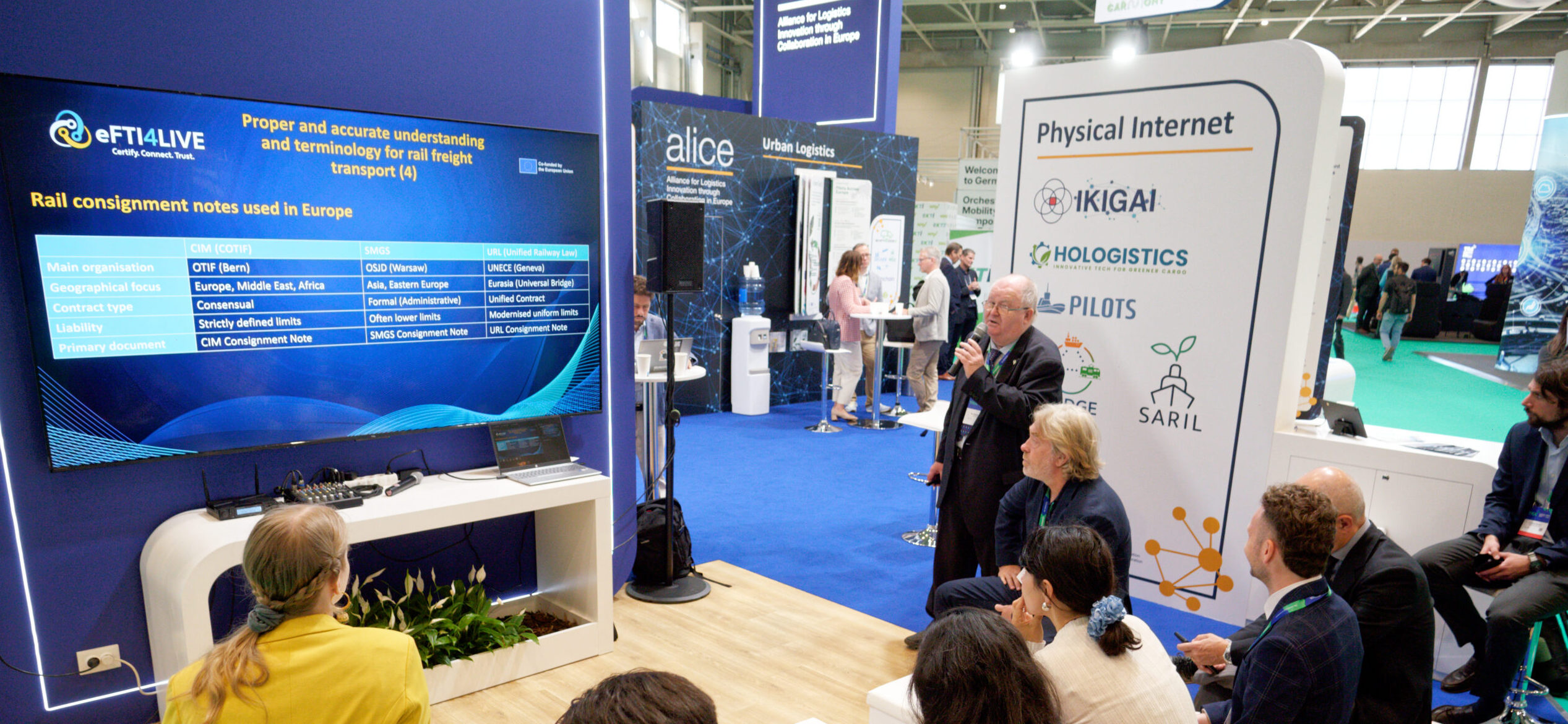
The eFTI4LIVE project, together with its sister projects eFTI4EU and eFTI4ALL, participated in the event through a shared presence at the ALICE pavilion, where the eFTI community showcased ongoing efforts to support the implementation of the Electronic Freight Transport Information (eFTI) Regulation and promote digital freight information exchange across Europe.
The event also offered numerous opportunities to engage directly with visitors and stakeholders interested in learning more about eFTI. Discussions at the stand focused on multimodal transport, interoperability challenges, and the practical implementation of digital information flows across different transport modes.
Among the contributions delivered during the event, two eFTI4LIVE presentations highlighted how eFTI can support data exchange in both the rail and inland waterway sectors.
Rail Transport Needs a Common Digital Language
In his presentation, Miroslav Haltuf (H-Comp Consulting) explored how eFTI can support the rail sector while respecting its specific operational and technical requirements.
A key message was that rail transport has its own data structures, identifiers, and standards, making interoperability particularly important. To enable efficient digital information exchange, rail data needs a common language that can be understood consistently by different systems and stakeholders.
This is where Telematics Applications TSI (TEL TSI) and the ERA Ontology become highly relevant. Together, they help define how rail information is structured, exchanged, and interpreted, covering elements such as wagon numbers, train identifiers, and loading units.
While eFTI provides the framework for the digital acceptance of regulatory freight information, rail transport requires sector-specific technical rules to make this exchange operational in practice. TEL TSI can help bridge this gap by supporting the integration of rail data into broader freight information flows.
This is particularly important for intermodal transport, where loading units such as containers move between different transport modes. By improving interoperability, digital information can follow the shipment more seamlessly as it moves from road to rail and beyond, reducing manual data entry and improving efficiency across the logistics chain.

Inland Waterways: Connecting Actors Through eFTI
A second presentation delivered by André Perpey (NeoGLS) focused on the inland waterway sector and how eFTI can facilitate information exchange between different actors involved in multimodal logistics operations.
The use case presented during the session examined a barge operator that had already developed a private digital solution for exchanging information with affiliated partners. While effective, this system covered only a limited share of shipments, leaving a significant number of actors outside the digital ecosystem.

In this context, eFTI can provide an additional channel for exchanging freight information between road hauliers, barge operators, and other stakeholders. Rather than replacing existing systems, eFTI can complement them by helping connect actors that are not yet integrated into private digital networks.
The benefits are clear: reduced administrative work, more standardised processes, fewer clerical errors, and improved coordination between transport operators.
The example demonstrated one of the key strengths of eFTI: its ability to facilitate information exchange across organisational and modal boundaries while remaining flexible enough to coexist with existing digital solutions.
Supporting Multimodal Connectivity Across Europe
The discussions held during TRA 2026 highlighted the importance of interoperability in enabling truly multimodal freight transport.
Whether in rail operations or inland waterways logistics, the ability to exchange reliable digital information between systems and stakeholders remains a fundamental requirement for achieving more efficient and connected supply chains.
Through its work on real-life multimodal use cases, eFTI4LIVE continues to demonstrate how eFTI can support this transition and help create a more integrated, interoperable, and digitally connected European transport ecosystem.